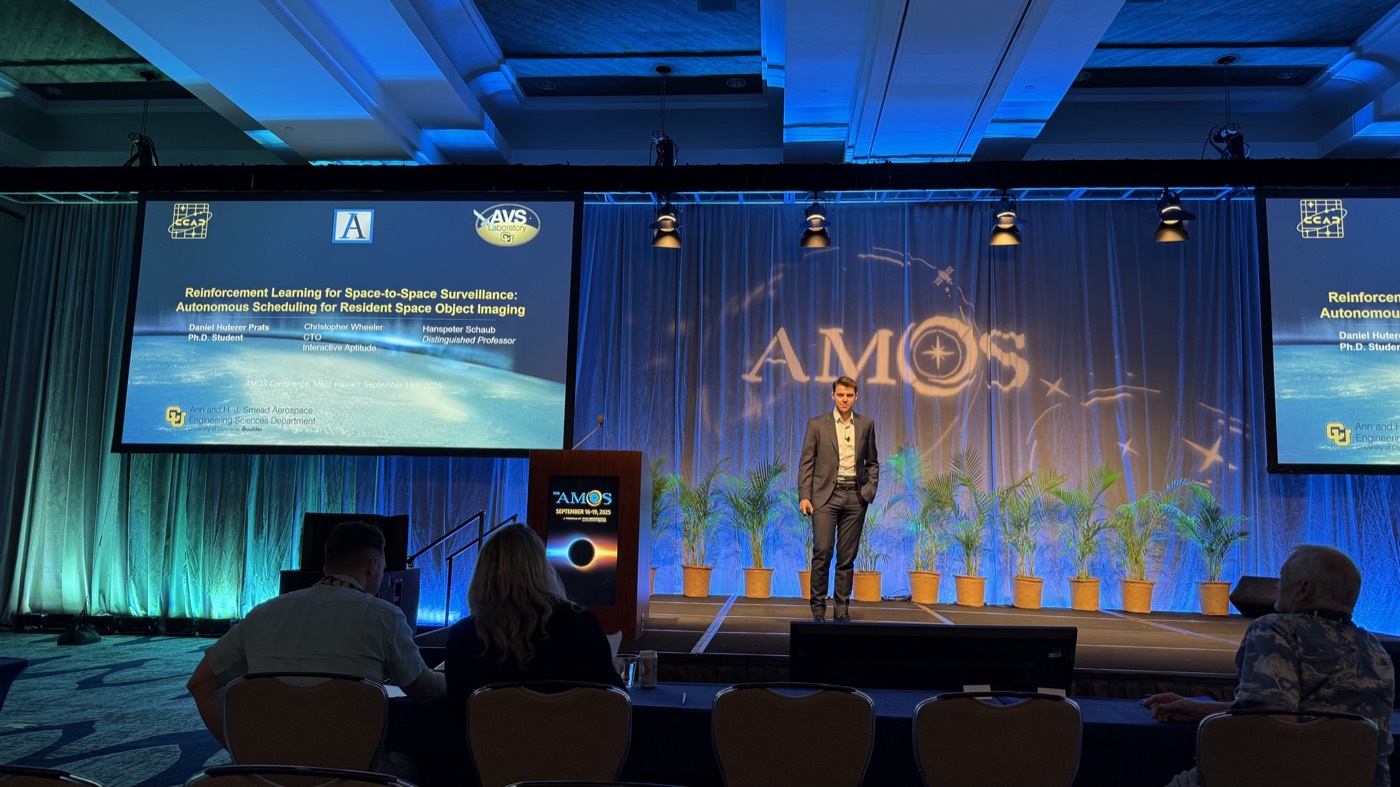
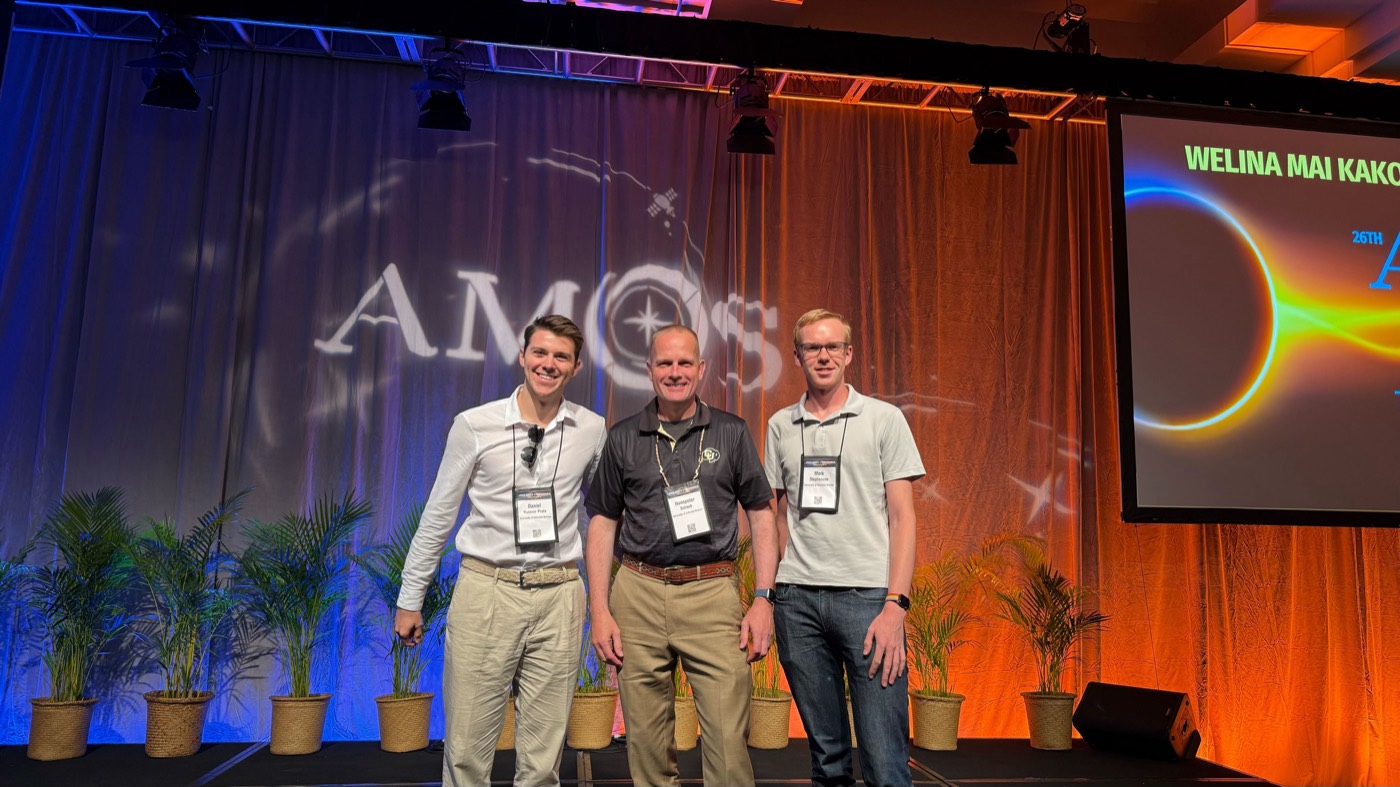
Overview & motivation
Space-based SSA is unlike Earth imaging. Targets move fast, access windows are brief, and power, pointing, and downlink are tightly constrained. The goal is a scheduling policy that decides which RSO to image and when to downlink, while keeping the spacecraft healthy for the next opportunity.
The main study focuses on LEO-to-LEO imaging, with rapidly changing relative motion, visibility, and illumination. Targets may be in eclipse even when the observing spacecraft is illuminated.
The journal extension, Autonomous LEO-to-LEO Resident Space Object Imaging with Reinforcement Learning, is under review at the Journal of the Astronautical Sciences. Later work examines imaging–downlink tradeoffs and responsive catalog maintenance at AMOS 2026.
Scenario & simulator
Polaris visualization from the AMOS 2025 presentation: a LEO observer imaging catalogued RSOs. Full 87-second simulation clip.
Formulating SBSS as a POMDP
The task is posed as a POMDP with observations of target geometry, spacecraft resources, and access opportunities. Target orbits are assumed known for scheduling. Actions select imaging, downlink, charging, or momentum-management tasks.
RL agent & training
Representative rollout segment showing target-selection and downlink behavior while respecting LOS, battery, and onboard data constraints.
An actor-critic policy learns target-selection and resource-management decisions through simulated rollouts. The conference paper describes the observation, action, reward, and training setup; the clips here illustrate the simulated task.
Results: behaviors & plots
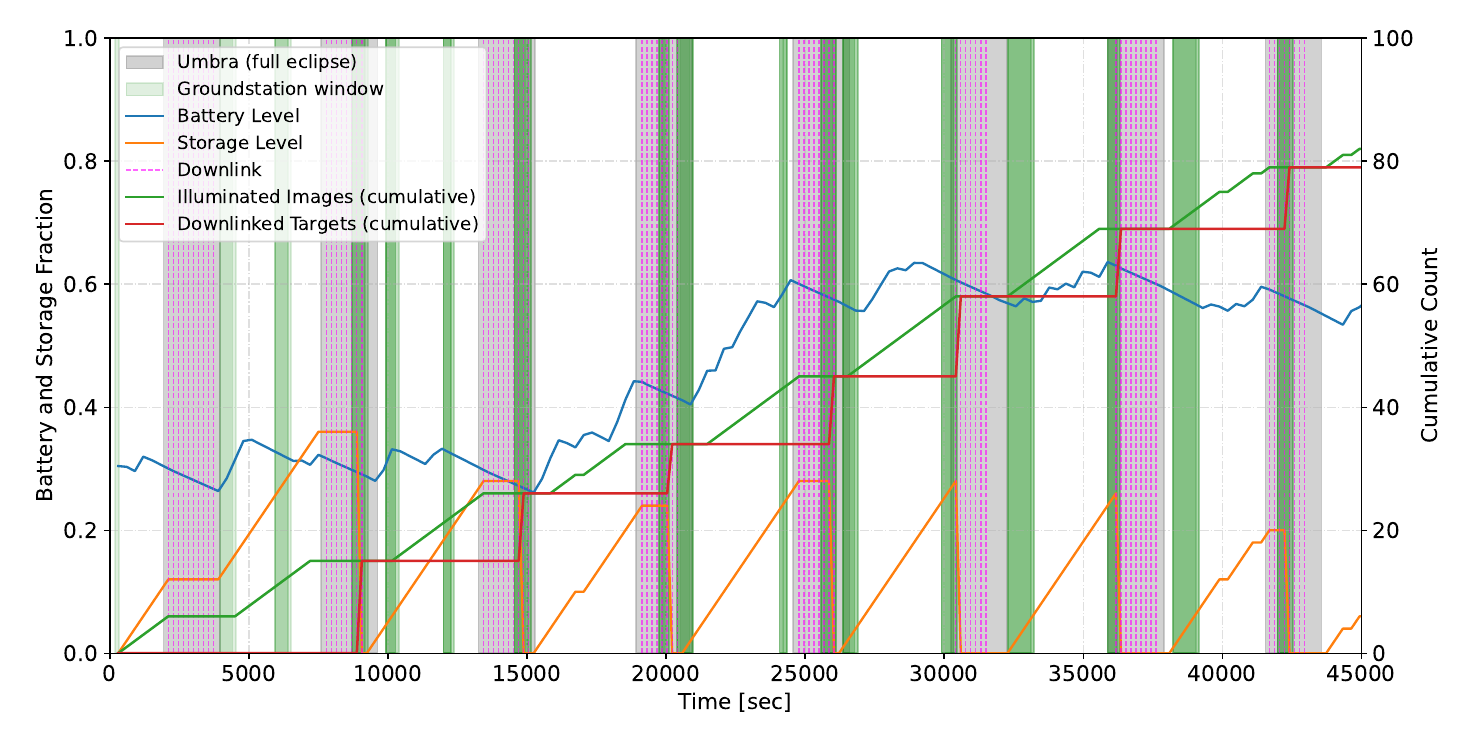
The resource-constrained Monte Carlo comparison reports 22.82 mean shield interventions for the heuristic and 3.26 for RL over 100 runs per policy. The heuristic collects slightly more illuminated images on average; see Table 6, page 10, in the paper.
- Energy/storage habits: preserves health margins while opportunistically imaging valid targets.
- Opportunistic imaging: adapts target choice to short-term geometry instead of rigid preplanned schedules.
- Ground delivery: selects downlink tasks to transfer collected images during access opportunities.
Additional illustrative simulation plots: battery and storage timeline and pointing and downlink windows.
Generalization: mixed LEO/MEO/GEO
With a target mix of around 50% LEO, 30% MEO, and 20% GEO, a policy trained on LEO still performs well. It reuses resource-management behavior and remains effective at selecting valid opportunities and scheduling downlink actions in the mixed environment.
Paper, slides & videos
Short visual summary from the AVS Lab YouTube channel.
Global perspective clip of the same run.
Photos
Conclusion
The study demonstrates learned imaging and resource-management behavior in simulation. The AMOS 2026 paper extends this research to repeat observations, changing priorities, and catalog maintenance across orbital regimes.